Professor Cornelia H. Dayton will present her essay “Lost Years Recovered: John Peters and Phillis Wheatley Peters in Middleton” at a Pauline Maier Early American History Seminar at the Massachusetts Historical Society on Tuesday, September 21 at 5:15pm EDT.
From MHS:
Litigation in Essex County reveals where the African-born poet Phillis Wheatley Peters and her husband John Peters went when they left Boston for three years starting in spring 1780. Peters came into possession of a substantial farm where he had been enslaved as a child. But his tenuous legal position and the hostility of many townspeople led to his eventually losing the land and deciding to move the family back to Boston. Panelists will discuss the implications of these new findings, the future research pathways they suggest, and investigative methods that expand our awareness of Black lives in the late eighteenth-century northeast. Attendees are invited to read the recently published article by Dayton that delineates the complicated litigation record.
The American Literature Society is pleased to invite submissions for the 1921 prize, which is awarded annually for the best article in any field of American literature. The prize is named for the year the organization was initially founded “to promote and diversify the study of American Literature.” Judged by a panel comprised of members of the American Literature Society Advisory Board and other scholars in the field, the competition will be divided in two categories: one for tenured faculty and one for graduate students, scholars in contingent positions, and untenured faculty members. The winner will be announced at the 2022 MLA awards ceremony.
Rules for competition:
Submissions must be published during the calendar year of 2021. For submissions that have not yet appeared in print by the October 1 deadline, authors are requested to provide verification that their essay will be published within the calendar year. [Because COVID- 19 has disrupted publication timelines, the ALS will consider any article to be published in a 2021 issue of a journal, even if the journal appears in print later].
No person may nominate more than one essay in a given year.
Articles on any field of American literature must appear in one of the following journals: African American Review; American Literary History; American Literary Realism; American Literature; American Periodicals; American Quarterly; Arizona Quarterly; Callaloo; Early American Literature; ESQ; J19; Journal of Ethnic American Literature; Legacy; MELUS; Modern Fiction Studies; Native American and Indigenous Studies (NAIS); Resources for American Literary Study; Studies in American Fiction; Studies in American Indian Literatures; The New England Quarterly. Essays that appear elsewhere will not be considered.
Authors must be members of the American Literature Society. Membership is free! For more about the American Literature Society, including a link to the online membership form and more about ALS awards, click here.
Please email an electronic copy of the nominated essay (PDF preferred) to the Prize Committee by October 1, 2021 to 1921prizeALS@gmail.com.
If you have any questions, please contact Dr. Alisha Gaines, American Literature Society Chair, at amgaines@fsu.edu.
The Colonial Society of Massachusetts has announced the 2021 Walter Muir Whitehill Prize in Early American History competition for essays on early American history (up to 1825), not previously published, with preference being given to New England subjects.
Essays are now being accepted for consideration. All manuscripts submitted for the 2021 prize must be emailed or postmarked no later than January 15, 2022. The Society expects to announce the winning candidate in the spring of 2022.
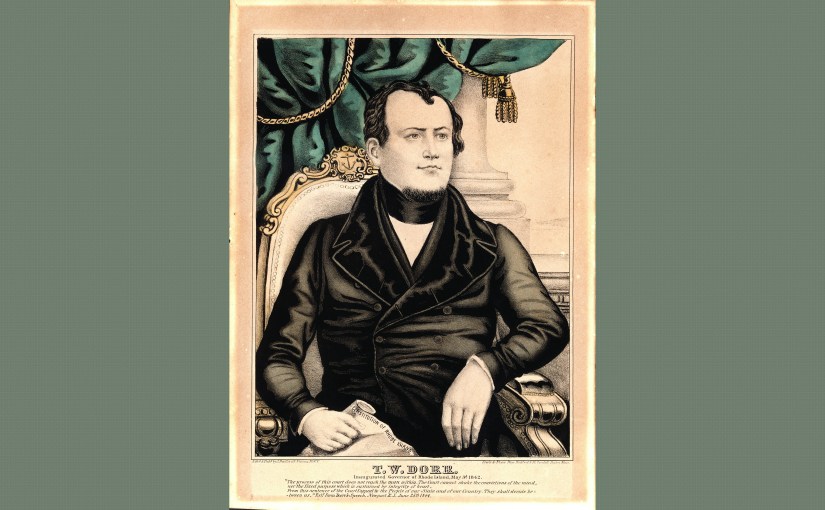
Though it is often labeled as a comic opera and frequently ignored by writers of 19th-century America, the 1842 Dorr Rebellion in Rhode Island was an event of major importance in the antebellum period and is by far the most well-documented event in the pre-Civil War period. Surprisingly and unbeknownst to even the most veteran historians of the nineteenth century, the Dorr Rebellion is the also the most well-illustrated event in early America. There are over two hundred known sketches and broadsides connected with the event. There are no comparable artistic drawings for the 1786–87 Shays Rebellion in western Massachusetts, the 1794 Whiskey Rebellion in western Pennsylvania, or the 1799 Fries Rebellion in eastern Pennsylvania, nor are there many images connected with the contemporaneous Anti-Rent Wars in New York.
In 2010, the digital service team at the Phillips Memorial Library at Providence College helped to bring the story of the Dorr Rebellion into the high school and college classroom.
The Dorr Rebellion Project was conceived of by Dr. Erik Chaput, Russell DeSimone, and Christiane Marie Landry in April of 2010. The project site was launched in September 2011 with an aim to develop an authoritative online educational resource on the Dorr Rebellion, engage in new forms of pedagogy, and add content over time to further elucidate the historical event. Aimed at upper level high school and college students, the website offers a gallery page, four digitized letter collections, a side-by-side comparison of various constitutions, a short documentary, digitized pamphlets, and lesson plans.
The story of the Dorr Rebellion represents a constitutional question of great moment for Americans before the Civil War that is often neglected in American history textbooks. The question was simple: who were the rightful monitors of the constitutional order? Today, many take it for granted that that function falls to the U.S. Supreme Court—a natural role of interpreting the meaning of the Federal Constitution. But that question was far from clear for Americans of an earlier generation. For them it seemed quite plausible that the Court, Congress, and the Executive each had roles, and what their interrelationship was remained uncertain. And, of course, even more outside of our “modern” understanding and yet clearly compelling to many Americans, was the possibility of the a role for “the people”—however one conceived them—as a check on unconstitutional actions of government. For teachers looking for ways for students to do a deep dive into an often-neglected aspect of popular sovereignty ideology in the decades before the Civil War, the Dorr Rebellion Project website offers access to vast array of primary material.
How to Use the Dorr Rebellion Project
To begin, teachers should have students watch the documentary covering the rebellion that appears on the homepage. Next, students should turn to the Gallery. The images in the gallery, along with the detailed captions, provide students with a rich visual experience supplementing the documentary. These include broadsides, handbills, political cartoons, manuscripts, election ballots, sheet music, suffrage ribbons, and images of Thomas Dorr and his family. All of these artifacts make useful teaching aides. For example, the political cartoon “Tyrants Prostrate Liberty Triumphant” can be used to explain the role of the rebellion in national politics, especially the presidential election of 1844.
“Tyrants Prostrate Liberty Triumphant.” Courtesy of the Dorr Rebellion Project.
“The Doctrine of Sovereignty,” written by Dorr in 1853, is a useful tool for classroom discussion because it clearly summarizes the notion of popular sovereignty.
Thomas Dorr, “The Doctrine of Sovereignty.” Courtesy of the Dorr Rebellion Project.
After a classroom session with the gallery page, students will be ready for the digital letter collections. Each letter is accompanied by an overview essay, along with headnotes, personagraphies, and specific guide questions to further understanding and spark conversation. Students should be instructed to make connections with the letters to images in the gallery.
The website’s newest digital letter collection, the Dorrite Women Letter Collection, provides a unique insight into antebellum America. These women, along with their husbands and children, were often connected to the Whig Party. However, Dorrite women, who mainly hailed from the lower ranks of society, were often unmarried, sometimes divorced, and most notably devout supporters of the Democracy, the name used at the time in reference to the party of Andrew Jackson. Although there was not an overt call for suffrage to be extended to females in 1841–42, Dorrite women still demonstrated a remarkable capacity for political agitation on behalf of disenfranchised males. Associations were formed in mill villages and towns, including Providence, Pawtucket, and Woonsocket. Ann Parlin referred to herself as the “presidentess” of a Ladies Benevolent Association. Parlin took on a public persona, speaking at meetings with predominantly male audiences in Providence and New York City. She even offered, according to historians Ronald and Mary Zboray, to lead a female militia company. Catharine Williams and Frances Harriet Whipple-Green took a less public role, preferring instead to use their pens. Whipple-Green is best known as the author of Might and Right, a full-length book published shortly after the rebellion.
For the more advanced classroom, the website devotes a page to the constitutions that were framed during the rebellion, thus providing for a critical analysis in the classroom of both the People’s and the Law & Order Constitutions. Special attention should be paid to the articles on suffrage, as there are significant differences in the two constitutions. To aid in this analysis, an article-by-article comparison chart is included on the site, as well as short introductory essays to each constitution. In support of a more detailed understanding of the rebellion, a resource page containing all the contemporary accounts and newspaper reminiscences is provided, as well as a selected bibliography for further study.
The New England Quarterly announces the publication of Volume 94.1: March 2021.
— Volume 94, Issue 1: March 2021 —
Editorial by Jonathan M. Chu
Anti-Abolitionism in New Engalnd
The “Abolition Riot” Redux: Voices, Processes by Lindsay Campbell
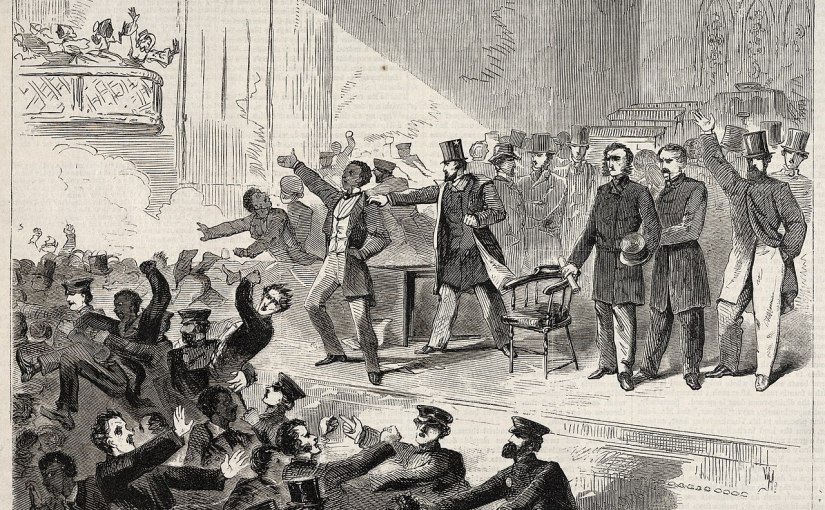
“This Most Atrocious Crusade Against Personal Freedom”: Anti-abolitionist Violence in Boston on the Eve of War by Patrick T.J. Browne
“Where the great serpent of Slavery … basks himself all summer long”: Antebellum Newport and the South by Richard C. Rohrs
Essay
Which Ethics for Essex? Elizabeth Gaskell, Salem Witchcraft, and the Problem of Forgiveness by Michael Everton
New Voices
The Never-Chosen: Samson Occom, the New Divinity, and Indigenous Self-Determination by Ryan Carr
Book Reviews
Shaker Vision: Seeing Beauty in Early America. By Joseph Manca. Review by Robert P. Emlen
Workers on Arrival: Black Labor in the Making of America. By Joe William Trotter Jr. Review by Sam Sommers
Rethinking Sympathy and Human Contact in Nineteenth-Century American Literature: Hawthorne, Douglass, Stowe, Dickinson.By Marianne Noble. Review by Timothy Matovina
Cross of Snow: A Life of Henry Wadsworth Longfellow. By Nicholas A. Basbanes. Review by John W. Crowley
Crying the News: A History of America’s Newsboys. By Vincent DiGirolamo. Review by James Schmidt
Saving America’s Cities: Ed Logue and the Struggle to Renew Urban America in the Suburban Age. By Lizabeth Cohen. Review by Clayton Howard
City on a Hill: A History of American Exceptionalism. By Abram C. Van Engen. Review by Patricia Roylance
Guest editors: Kerri Greenidge (Tufts University) and Holly Jackson (UMass Boston)
In Dusk of Dawn (1940), W.E.B. Du Bois referred to his New England boyhood in Great Barrington, Massachusetts, as being “shut in by its mountains and provincialism.” Similarly, the Jamaican-born poet Claude McKay used “Spring in New Hampshire” (1922) as a metaphor for racial isolation and loneliness in what was then, as now, one of the “whitest” states in the Union. Alongside these characterizations of New England as a site of Black isolation in a sea of whiteness, Black people and their communities have defied erasure. Even as white Bostonians threw rocks and racial slurs at Black school children in 1974, for example, Barbara Smith expanded the radical feminism(s) of the National Black Feminist Organization in the Boston-based Combahee River Collective. New England as a region, cultural concept, and political imaginary has shaped Blackness across the African diaspora since the first Africans arrived in colonial Massachusetts in the 1630s. More importantly, African-descended people – Black and Afro-Native – have consistently shaped New England culture and politics, though their contributions have been undervalued in both scholarly and popular accounts of the region. In contrast to F.O. Matthiessen’s canonization of New England’s flowering – which ignored the significant contributions of William Wells Brown, Harriet Wilson, Maria Stewart, Ann Plato, and David Walker – a region defined by its supposed whiteness has long been the site of Black defiance, providing intellectual and political sustenance to Malcolm X and Martin Luther King, Jr., Pedro Albizu Campos, and Melnea Cass.
The New England Quarterly seeks submissions that center Black, Afro-Native, and trans-national Black politics within New England history, literature, and culture. How has Blackness shaped the politics, culture, and racial capitalism of these six states that are consistently ranked among America’s most “highly educated,” most “economically stable,” and most reliably politically liberal, but also marked by high levels of racialized wealth inequality and residential segregation? How has Blackness shaped America’s colonial project, from the ongoing process of tribal erasure, through the violent implementation of New England capital across the Global South? Topics can include, but are not limited to: Afro-Native communities; trans-national Blackness from Paul Cuffe to Amilcar Cabral; Black feminisms; Black literary, artistic, and intellectual traditions; Black material cultures, food cultures, or kinships. We welcome historical, literary, and anti-colonial scholarship, on any period, that explores Black and African diasporic communities across the region, including Boston and the Harbor Islands, Worcester and Portland, Providence and New Haven, trans-national political networks between New Bedford and Cape Verde, Hartford and Jamaica, Bangor and Somalia. We invite submissions from graduate students and early-career scholars, women, queer and trans scholars, including those working outside of academia.
The Library of America celebrated the life of our dear friend Professor Bernard Bailyn with a conversation among three eminent historians: Gordon S. Wood of Brown University, Richard D. Brown of the University of Connecticut and President of New England Quarterly, Inc., and Robert J. Allison of Suffolk University. You can read their conversation here.



![A manuscript on one sheet of off-white paper written in cursive. There are a few words crossed out and inserted, indicating this is not a polished final draft. The underlined title reads, "The Doctrine of Sovereignty." The rest of the text reads, "There is One over all, God [illegible] forever; and under him the People are sovereign. This Revealed Word is the higher law, to whose principles and rules of action recourse is had by the frames of Constitutions & by legislators, to inpart justice and equity to political institutions. The application of these principles & rules to the Constitutions and legislation acts of States, and to men in their political relations, is what has been called the democracy of Christianity.Rights are the gift of God. The definition and protection of them are the objects of just government." It is signed, "Tho's W. Dorr, Providence, R.I., Aug. 10th, 1853."](https://lh5.googleusercontent.com/S_L8rQDUGJ2ux_-Dy2ZHhK1-dc-T995UA9kETRtC4KEhBIQA8QZ8T-GIuTIeT0KCU-V7Sp-1Ho2WvHmfiM9DY21N2kTf4j0skvwXTuZWP-tcnNVrJ7P0EaB2V6N5XPi_QnzNsEk)


 THE NEW ENGLAND QUARTERLY